

Monday, June 3, 2013
Mary Jane's Farm
Mary Jane's Farm is a sisterhood that you can join. My Mom is a member. You're able to earn badges by doing things like recycling things from around your house. When you're done doing that, you take a picture of what you've done, send it in, then you get a badge. Mary Jane's Farm also has a program for young ladies. It is called Young Cultivators. You do things like, learn how to organize, survival techniques, gardening, and even the "art of grass whistling". It's not just about gardening, it teaches you about everyday life things. I having lots of fun working on earning my badges. I think any girl would love doing this.

Friday, May 17, 2013
A Big Mothers Day!
Mothers Day was really big this year at my house.
On Sat afternoon the baby Barred Hollands started pipping
on their eggs. We waited and waited, but none of them hatched out.
They took lots of naps though......hatching out is hard work.
My mom and I stayed up late Saturday night watching them pip away.
I was so tired I fell asleep on the couch.
Then at 1:45 am my mom woke me up to let me know that the first little guy
had broken through his shell and was looking around. I could hear him tweeting
up a storm so I jumped up to go see.
The cutest ever!!!
My stayed up all night to make sure all four peeps made it through.
Of course one waited until Breakfast to hatch out.
 |
| Chicks just beginning to pip through |
 |
| Making more progress after a nap |
 |
| Now really getting down to business |
 |
| I am ready to face the world |
 |
| This really Hard! |
 |
| I am upside down |
 |
| Get this shell off of me! |
 |
| I can stretch --at last |
 |
| Come on Buddy get up |
 |
| OK world here I am |
 |
| Little friends togther |
 |
| All dry and fluffy |
 |
| Cute Barred Holland Chicks DOB-May 12,2013 Happy Mothers Day! |
Thursday, May 9, 2013
The Count Down!!!
The Count Down Has Begun!!!!
In less than three days our new family members will be here.
The eggs started rocking back and forth several days ago.
It was so weird. We were standing next to the incubator and
I noticed it first, then my mom. My oldest brother, Andrew walked up
and said "Why are the eggs rocking back and forth?"
Those little guys are ready to make an entrance and move into
bigger living quarters.
I started out with seven fertile eggs, sent to me by Sue from the Pocket Farmer
My Brinsea incubator holds seven eggs.
Shipping fertile eggs is risky. So many things can happen to keep the eggs from
hatching out. At the first candling, I learned that one egg did not start the development stage.
That could be for any number of reasons. Not fertile, damaged in shipping somehow
or compromised by bacteria. I removed that egg.
The six remaining eggs were candled at 10 day. All looked great accept for
two that were developing but not at the same rate.
I left them in and decided to check on them a little later on.
Day 18 and time to check the "rocking" eggs.
The two eggs in question were indeed in trouble. One developed a chick but the chick died
early. I am not sure why. The other egg, started developing and then stopped.
The other four are strong and ready to hatch.
I can not wait to meet them!
Monday, April 29, 2013
Day Six Update
Over the weekend my mom
help me candle my Barred Holland eggs.
It was very exciting to see how the peeps were
doing inside their shells.
I have a special light that I use to candle the eggs.
It is very bright, but lets off "cool" light so the peeps
are not hurt. I carefully take one egg at a time
from the incubator and hold the light to the bottom
of the egg. My mom helps me with this and we
wait until night time when it is dark.
I have seven eggs in my incubator. When you have
eggs shipped through the mail, you have to
understand that not ALL of the eggs are going to hatch.
It is rough on the eggs bouncing around in the mail
with the different air temps. and pressures.
I only hatched out three Buff Orpingtons
for my first hatch.
But that is why you candle the eggs, to see how they are doing.
So far, only one is looks like it did not develop at all.
I have included pics. from online of egg candling. One of a
good egg at six days and one of a bad egg at six days.
 |
| This is a Good Egg --see the veins and the Peep? |
 |
| This is a Bad Egg--No Veins..No Peep |
Thursday, April 25, 2013
Holland Eggs in Incubator
Ok the eggs are in the incubator.
The count down has begun.
My mom will help me candle them Friday
evening which will make day five.
I will do an update to let you know how they are
coming along.
 |
| I have a Brinsea seven egg Incubator |
 |
| It provides the perfect place for the growing chick inside the egg Barred Holland eggs are white. That is a determining factor of whether they meet the "Standard" or not. The "Standard" for all regconized breeds can be found in the Standard of Perfection Book which is like a chicken breeders (especially if you show chickens) bible. I have more tid- bits of interest about the Holland breed, but I will share it little at a time. So stay tuned. |
Wednesday, April 17, 2013
Barred Hollands
I went to "Show" for the first time this year with 4-H.
It was fun and I really did learned so much.
But I realized as I looked through this book (The Standard of Perfection)
that many of the breeds were not being shown.
Then as I my mom and I really started looking online we realized that most
people like to show popular breeds and the other ones are dying out.
We started looking at the critical list (chickens with less than a thousand nation wide).
And....We found "The Holland"
Holland Chicken
In 1934 white eggs brought premium prices at market because it was believed that white eggs had a finer, more delicate flavor. At that time most of America’s eggs were produced on small farms all across the country, and small farmers preferred dual-purpose chickens as these provide a source of meat as well as eggs. Since dual-purpose chicken breeds tend to lay brown eggs, and white egg-laying breeds available at the time were light-weight and not well fleshed, this prompted Rutgers Breeding Farms to set about producing a dual-purpose breed that would lay white eggs – resulting in the Holland.You may wonder why an American breed of chicken is called “Holland.” The answer lies in the ancestry of the breed. Breeders began with light-weight stock originally imported from Holland, and mated it with White Leghorn, Rhode Island Red, New Hampshire, and Lamona. Through careful selection the White Holland was created. Simultaneously, the Barred Holland was created by mating White Leghorn, Barred Plymouth Rock, Australorp, and Brown Leghorn. The breed was admitted to the American Poultry Association Standard of Perfection in 1949.
Hollands have earned a good reputation as being ideally suited to farm conditions. They are good foragers with calm temperaments. The breed is fairly cold tolerant, though during periods of extreme cold the males may suffer some frostbite to their single combs. The hens can become broody and will sometimes raise their own offspring. Hollands also tend to have a slow to moderate growth rate. But this fact must be weighed against their ability to rustle a significant portion of their own food.
In its time, the Barred Holland was much more popular with the farmers than was the White Holland. This may have been because of the popularity of the Barred Plymouth Rock, or it may have been for the practical reason that a chicken with a pattern is less likely to suffer predation than a white chicken. The less popular White Holland may well be extinct now.
While the Holland has never enjoyed widespread popularity, it is an excellent choice for homesteaders or use on small acreages. These chickens have yellow skin and legs, so will produce a carcass with the skin color most Americans favor. The Holland will produce plenty of medium-large white eggs, and one can enjoy the fact that they are helping to conserve what is likely the rarest, living breed of American chicken.
My first batch of Hollands came two weeks ago from a breeder in New York.
I have eggs coming this week from Sue at the Pocket Farmer and
they will go into the incubator this weekend. In 21 days I will
hopefully hatch my second group of Hollands.

Monday, April 15, 2013
The Buffs Begin
Rosie was my first Buff Orpington.
She has a Fluffy back side and a wonderful chicken-ality.
She is very sweet and fat....and Arthur R E A L L Y likes her,
so much so that I had to have my mom make her an apron to wear.
But....Rosie was a lone Buff Orpington in my flock, standing there all
gold and fluffy. She needed to have her numbers multiplied.
With my mom and dad's help, I was able to buy a Brinsea Incubator, purchase
some fertile eggs from a breeder.
My first hatching was this past Friday April 12, 2013.
Three fluffy Buff Orpingtons Hatched.
Not a big hatch I know. My incubator holds seven eggs and I knew
that not all of them would hatch. Shipping the eggs lowers the hatch rate, I have
heard. I let them rest for 18 hrs. according to the Brinsea directions.
I think maybe I should have let them rest for 24 - 48 hrs.
This week, Ms. Sue from The Pocket Farmer is sending me Barred Holland eggs.
This will be my second hatch. I received my first batch of Barred Holland Biddies two weeks
ago and that began my Holland Project.
More to come on that.
More to come on that.
 |
| Buff Orpington Egg |
 |
| First to Pip Through |
 |
| Here She Comes! |
 |
| What a Beauty! |
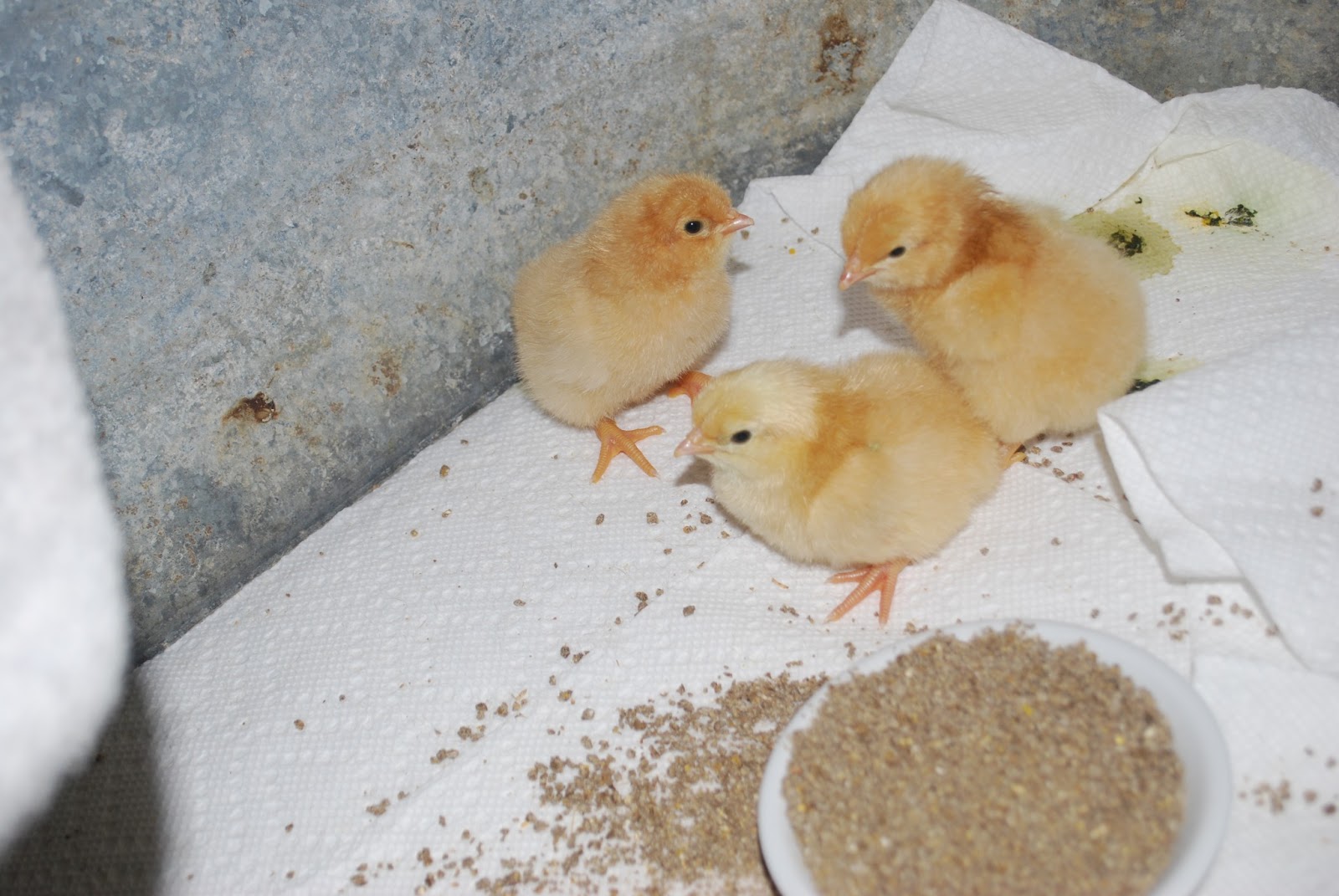 |
| Fluffy and Perfect! Rosie will be so excited! |
Subscribe to:
Posts (Atom)